

Most men know they should exercise. Fewer know which exercises are backed by solid research when it comes to the things that matter most: heart health, hormone balance, mental wellbeing, and long-term vitality. The good news is that the science is clearer than most gym conversations suggest.
This guide walks through the exercise categories that have the strongest clinical evidence for men’s health, explains what the research actually says, and gives you a practical picture of what to prioritise. No fads, no vague claims. Just a clear-eyed look at what works.
TL;DR A 2024 analysis of over 216,000 participants in the NIH-AARP Diet and Health Study found that any amount of weight training was linked to an 8% lower risk of cardiovascular mortality.[1] The best approach for men combines resistance training with regular aerobic activity. If you are unsure where to start, speaking with a doctor or qualified exercise professional is the most reliable next step.
Why Resistance Training Is the Foundation of Male Health
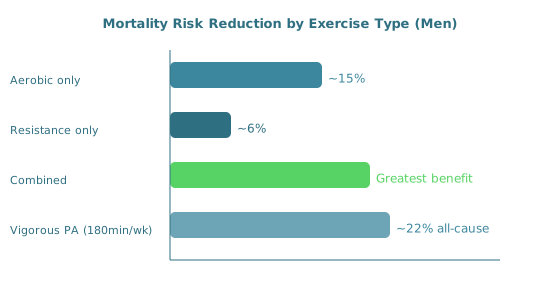
Resistance training, which means any exercise where your muscles work against a load, produces some of the most well-documented health benefits for men. A large 2024 cohort study drawing on the NIH-AARP Diet and Health Study followed over 216,000 adults and found that engaging in any amount of weight training was associated with a 6% lower risk of all-cause mortality and an 8% lower risk of cardiovascular disease mortality, compared to those who did no weight training.[1]
Importantly, the study found that combining both aerobic exercise and weight training produced the greatest mortality risk reduction. Weight training alone, without any aerobic activity, was not significantly associated with reduced mortality in that data set.[1] This tells us resistance training is most effective as part of a complete programme.
What Resistance Training Does for Your Muscles and Bones
Men naturally lose muscle mass from around their mid-30s onwards, a process called sarcopenia. Resistance training is the most effective tool available to slow this process. A 2024 PMC meta-analysis found that resistance training significantly increased muscle cross-sectional area and muscle volume in the groups studied, with muscle strength showing a large effect size across all conditions.[2]
Bone health is equally important. Resistance training applies mechanical stress to bones, which stimulates them to maintain or increase density. This matters most as men age, since fracture risk rises significantly after 60.
How Much Resistance Training Do You Need?
Research from the 2024 PMC meta-analysis suggests that two to three sessions per week produced the best results for muscle volume and strength gains in the populations studied.[2] Start with compound movements that use multiple muscle groups: squats, deadlifts, rows, and bench press. These recruit more total muscle tissue and produce greater hormonal and metabolic responses per session than isolation exercises.
Aerobic Exercise and Cardiovascular Protection
Heart disease remains one of the leading causes of death in men. Aerobic exercise, which raises your heart rate and keeps it elevated over time, is one of the most reliably protective things you can do. A 2024 systematic review and meta-analysis found that engaging in 180 minutes of vigorous physical activity per week was associated with a 22% reduction in all-cause mortality and a 23% reduction in cardiovascular disease mortality compared to light-to-moderate intensity activity.[3]
You do not need to run marathons. The research shows a dose-response relationship: even going from completely sedentary to mildly active produces large improvements. Further gains come with more activity, but the biggest jump in benefit happens when you start moving at all.
Aerobic Exercise and Erectile Function
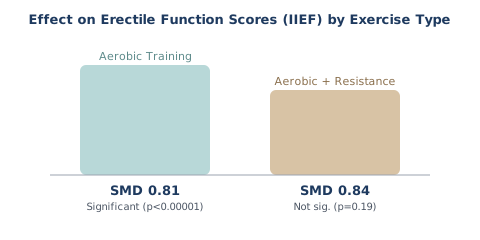
This is a connection many men are not aware of. Erectile function depends heavily on healthy blood flow, and the same cardiovascular mechanisms that protect your heart also influence sexual health. A 2023 systematic review and meta-analysis published in the Journal of Sexual Medicine found that regular aerobic exercise produced significant improvements in erectile function scores, particularly in men with lower baseline scores.[5]
A separate 2024 meta-analysis published in the journal Andrology, which included seven randomised controlled trials, found a standardised mean difference of 0.81 for aerobic training’s effect on erectile function scores, a clinically meaningful improvement.[6]
Walking briskly, cycling, swimming, or jogging for 30 minutes at moderate intensity on most days of the week is a reasonable starting point for men looking to support cardiovascular and sexual health simultaneously.
High-Intensity Interval Training (HIIT): A Time-Efficient Option
High-intensity interval training alternates short bursts of near-maximal effort with recovery periods. It is not just a trend: HIIT has a growing body of evidence behind it for male health, particularly for men with limited time.
Research has found that high-intensity resistance training, including heavy weightlifting and sprint intervals, can produce short-term increases in testosterone. A systematic review cited in Sports Medicine Open (2024) found that aerobic exercise training improved testosterone concentrations specifically in men with obesity or type 2 diabetes.[7] These are acute hormonal effects and do not persist permanently, but they contribute to cumulative metabolic benefits over time.
A 2024 study published in the International Journal of Clinical and Health Psychology found that a HIIT intervention over two weeks reduced symptoms of premature ejaculation in men.[8] While this is a small and specific finding, it points to the broader role that cardiovascular fitness plays in male sexual function.
Exercise and Mental Health in Men: What the Data Shows
Mental health is inseparable from physical health, and men in particular often underreport anxiety and depression symptoms. Exercise is one of the few interventions with consistent evidence across both conditions.
A 2023 meta-analysis published in Frontiers in Public Health, covering 12 studies, found that exercise significantly reduced anxiety (standardised mean difference -0.81) and depression (-1.02).[9] The greatest reductions were seen with sessions of 30 to 40 minutes performed three to five times per week.
Resistance training specifically has received increasing attention for its mental health effects. A 2024 review published in Trends in Molecular Medicine described the growing evidence base for resistance exercise as a potential support for anxiety and depressive symptoms, noting that it works through multiple biological pathways including changes in cerebral blood flow and insulin-like growth factor activity.[10]
These findings do not mean exercise replaces professional mental health care. If you are experiencing significant symptoms of depression or anxiety, speaking with a doctor or mental health professional is the right first step. Exercise works best as part of a broader approach to wellbeing.
Flexibility, Mobility, and the Exercises Men Often Skip
Flexibility and mobility training receives far less attention than lifting or running, yet it plays a practical role in keeping men active long-term. Injuries, particularly to the lower back, hips, and knees, are among the most common reasons men stop exercising in middle age.
Stretching, yoga, and targeted mobility work support joint range of motion, help reduce muscle soreness after training, and may lower injury risk over time. While the direct mortality data for flexibility training is less robust than for aerobic or resistance exercise, its role in sustaining a consistent exercise routine gives it indirect value.
How to Include It Without a Major Time Commitment
- Spend 5 to 10 minutes stretching major muscle groups after each workout while muscles are warm
- Consider one dedicated yoga or mobility session per week, particularly if you have desk-bound work
- Hip flexor and thoracic spine mobility work are especially relevant for men who sit for long periods
How to Structure a Weekly Exercise Programme for Men’s Health
The research consistently points to one clear conclusion: combining aerobic activity with resistance training produces the best overall outcomes for male health. A practical weekly structure does not require hours in the gym.
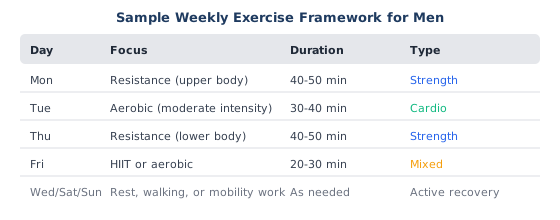
This structure aligns with the general findings that combining aerobic and resistance training provides the greatest mortality and health benefits.[1] It is not prescriptive: starting with two days per week and building gradually is entirely valid, especially if you are returning to exercise after a break.
Medical Treatment Options for Men’s Sexual Health
Exercise supports cardiovascular and hormonal health, but some men also experience specific conditions such as erectile dysfunction that may benefit from medical treatment alongside lifestyle changes. If you have spoken with a doctor and they have recommended a PDE5 inhibitor (a class of prescription medication that improves blood flow to support erections), there are several options available.
Treatment Options Available at PillsPlace
The following medications are PDE5 inhibitors used by men under medical guidance for erectile dysfunction. Always consult a doctor before use. These are not suitable for everyone, particularly men with cardiovascular conditions or those taking nitrates.
- Fildena 120mg – Sildenafil-based tablet. Typically taken as needed, approximately one hour before activity.
- Fildena Double 200mg – Higher-dose sildenafil formulation. Use only under medical supervision.
- Cenforce 200mg – Sildenafil citrate 200mg. Not suitable for first-time users without medical assessment.
- Vidalista 20mg – Tadalafil-based option with a longer window of action (up to 36 hours in clinical studies).
- Tadalista 40mg – Higher-dose tadalafil formulation. Discuss appropriateness with your doctor.
Always consult a doctor before use. Prescription medications carry risks and contraindications that require personalised medical assessment.
Visit PillsPlace for more information.
Conclusion
The evidence is clear that regular exercise, specifically a combination of resistance training and aerobic activity, offers meaningful benefits across nearly every dimension of male health: heart protection, hormonal balance, sexual function, and mental wellbeing. You do not need a perfect programme to start seeing results. Any consistent movement is better than none.
The most important practical takeaway from the research is this: do not choose between lifting and cardio. The studies consistently show that men who do both live longer and stay healthier than those who do only one or neither. Start where you are, build gradually, and check with a doctor if you have any underlying conditions before increasing intensity.
FAQs.
How often should men exercise to see real health benefits?
Can exercise improve testosterone levels in men?
Does aerobic exercise help with erectile function?
What exercises work best for men's mental health?
Is it safe for older men to begin strength training?
References
- NIH-AARP Diet and Health Study Investigators. “Weight training and risk of all-cause, cardiovascular disease and cancer mortality among older adults.” International Epidemiological Association / PMC, 2024. View source
- Chen A, Guo C, Zhou Y. “Effects of resistance training on preventing muscle atrophy and bone loss in simulated weightless population: a systematic review and meta-analysis.” Frontiers in Physiology / PMC, 2025. View source
- Systematic review and meta-analysis authors. “Associations of the volume and proportion of vigorous-intensity physical activity with all-cause, cardiovascular, and cancer mortality.” PMC / PubMed, 2024. View source
- Kodama S, Saito K, Tanaka S, et al. “Cardiorespiratory fitness as a quantitative predictor of all-cause mortality and cardiovascular events in healthy men and women: a meta-analysis.” JAMA, 2009. View source
- Khera M, Bhattacharyya S, Miller LE. “Effect of aerobic exercise on erectile function: systematic review and meta-analysis of randomized controlled trials.” Journal of Sexual Medicine, 2023. View source
- Chen et al. “Effect of different physical activities on erectile dysfunction in adult men not receiving phosphodiesterase-5 inhibitors therapy: A systematic review and meta-analysis.” Andrology (Wiley), 2024. View source
- Healy R, Patten R, Bauer C, et al. “The Effects of Aerobic Exercise Training on Testosterone Concentration in Individuals Who Are Obese or Have Type 2 Diabetes: A Systematic Review and Meta-Analysis.” Sports Medicine Open, 2024. Referenced in: Walia et al., Trends in Urology and Men’s Health, 2025. View source
- Niu C, Wen G, Ventus D, et al. “High-intensity interval training (HIIT) and slow breathing interventions alleviate premature ejaculation symptoms.” International Journal of Clinical and Health Psychology, 2024. View source
- Wang C, Tian Z, Luo Q. “The impact of exercise on mental health during the COVID-19 pandemic: a systematic review and meta-analysis.” Frontiers in Public Health / PMC, 2023. View source
- Gordon BR et al. “Resistance Exercise for Anxiety and Depression.” Trends in Molecular Medicine / PMC, 2024. View source