If you have adult ADHD and stimulants have not worked well for you, there is a good chance modafinil has come up in a search or a conversation with a friend. It is a wakefulness-promoting medication, and some doctors prescribe it off-label to help with focus. But the evidence behind that use is more mixed than most articles let on.
This guide walks through what modafinil actually is, why it gets used for ADHD despite lacking approval for it, what the clinical trials found in children versus adults, and what a realistic conversation with your doctor might look like.
TL;DR: Modafinil is not FDA-approved for ADHD in adults or children. Pediatric trials showed symptom improvement over placebo,1 but the largest adult-only trial found no statistically significant benefit versus placebo.3 If focus problems are affecting your daily life, talking with a doctor about a full evaluation is the most reliable next step.
What Is Modafinil and Why Do People Use It for ADHD?
Modafinil is a wakefulness-promoting agent approved by the FDA for narcolepsy, obstructive sleep apnea, and shift work sleep disorder, not for ADHD.2 It works differently from classic stimulants like methylphenidate or amphetamine salts, producing a milder, more gradual rise in dopamine activity while also affecting the orexin and histamine systems involved in alertness.
That different mechanism is exactly why some clinicians consider it off-label. Adults who feel wired, anxious, or “crashed” on traditional stimulants sometimes tolerate modafinil’s steadier profile better. It is not habit-forming in the way controlled stimulants can be, and it does not appear to disrupt normal sleep architecture the way some stimulants do.
Is Modafinil FDA-Approved for ADHD?
No. Modafinil’s only FDA-approved uses are narcolepsy, obstructive sleep apnea, and shift work sleep disorder, each at a standard dose of 200 mg once daily.2 A pediatric development program for ADHD was pursued in the early 2000s, but it was never approved, partly because of rare but serious skin reactions, including Stevens-Johnson syndrome, seen in some pediatric trial participants.2
When a doctor prescribes modafinil for ADHD today, in an adult or a teenager, that prescription is off-label. Off-label does not mean illegal or unusual. It means the FDA has not reviewed clinical trial data specifically for that use and formally approved it. The decision comes down to a doctor’s clinical judgment, your treatment history, and an honest conversation about what the evidence does and does not show.
What Does the Clinical Research Say?
Here is where the picture gets more nuanced than most headlines suggest. In a 9-week, placebo-controlled trial of children and adolescents with ADHD, modafinil reduced ADHD Rating Scale scores significantly more than placebo, both at school and at home.1 Roughly half of the modafinil group were rated as clinical responders, compared to about 18% on placebo.1
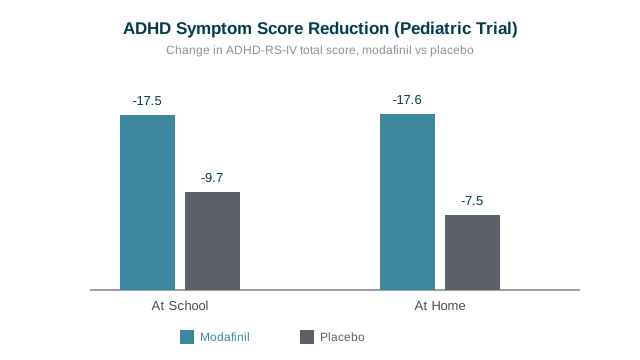
A meta-analysis pooling several short-term, placebo-controlled trials confirmed this pattern, finding a moderate effect size favoring modafinil on both home and school symptom scores.4 But nearly all of the trials in that pooled analysis were conducted in children and adolescents, not adults.
The picture changes for adults specifically. The largest randomized, placebo-controlled trial designed for adults with ADHD tested modafinil at four different doses against placebo over 9 weeks in 338 participants. On the primary outcome, the Adult ADHD Investigator Symptom Rating Scale, there was no statistically significant difference between any modafinil dose and placebo at the final visit.3
How Does Modafinil Compare to Traditional ADHD Treatments?
Stimulant medications, methylphenidate and amphetamine-based products, remain the first-line, best-studied treatment for adult ADHD, with decades of trial data supporting their effectiveness.5 Non-stimulant options like atomoxetine and certain extended-release alpha agonists are also FDA-approved alternatives when stimulants are not a good fit.
Modafinil sits outside both of those approved categories. Some adults are drawn to it because it carries a lower reported potential for misuse than classic stimulants and does not typically cause the same rebound or “crash” some people describe with short-acting stimulants. Others find it does not meaningfully improve their attention at all, which lines up with the neutral result from the pivotal adult trial.3
| Factor | Stimulants (methylphenidate, amphetamine) | Modafinil |
|---|---|---|
| FDA approval for ADHD | Yes | No, off-label only |
| Adult trial evidence | Extensive, well established | Mixed, pivotal trial was neutral3 |
| Typical dosing | Once or twice daily, varies by product | Once daily in the morning |
| Common side effects | Appetite loss, insomnia, increased heart rate | Headache, insomnia, decreased appetite1 |
Who Might a Doctor Consider Modafinil For?
Doctors sometimes raise modafinil as an option for adults who have not tolerated standard stimulants well, who have a history that makes controlled stimulants inadvisable, or who deal with significant daytime fatigue alongside their attention symptoms.5 It is never a first choice, and it is not a substitute for a full ADHD evaluation.
Because the adult efficacy data is thin, most clinicians treat modafinil as a conversation starter rather than a guaranteed fix. Would it be reasonable to try it if nothing else has worked? Possibly, but only with close monitoring and realistic expectations set in advance.
What Does the ADHD Treatment Landscape Look Like for Adults?
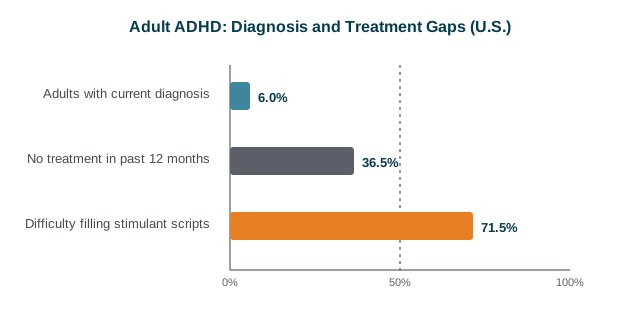
An estimated 6.0% of U.S. adults, about 15.5 million people, currently have an ADHD diagnosis, and more than half were diagnosed after turning 18.5 Despite that scale, treatment gaps are common and medication access is not always straightforward.
Side Effects and Safety Considerations
The most commonly reported side effects of modafinil include headache, insomnia, nausea, and decreased appetite, occurring significantly more often than with placebo in controlled trials.1 Cardiovascular monitoring matters too, since modafinil can affect blood pressure and heart rhythm in some patients.2
Modafinil also induces liver enzymes that break down hormonal contraceptives, which can reduce their effectiveness, an important consideration for anyone relying on the pill, patch, or ring for birth control.2 Serious skin reactions are rare in adults but were significant enough in pediatric trials to affect the drug’s regulatory history, and any new rash while taking modafinil warrants immediate medical attention.2
Medical Treatment Options
For adults exploring modafinil with a prescriber’s guidance, generic modafinil is available in a few standard formulations. These are prescription medications, not lifestyle supplements, and none of them should be started without a doctor’s evaluation and ongoing follow-up.
Generic Modafinil Options Through PillsPlace
Once a doctor has evaluated your history and confirmed a prescription is appropriate, PillsPlace carries several generic modafinil formulations for patients managing narcolepsy-related conditions or using modafinil off-label under medical supervision.
Modalert 200
A standard 200 mg generic modafinil tablet, the typical starting strength for adult wakefulness support.
Modalert 100mg
A lower-strength option for patients whose prescriber recommends a more conservative starting dose.
Modvigil 200
An alternative generic modafinil formulation at the same standard 200 mg strength.
Modaheal 200 Mg
Another generic modafinil brand offering the same active ingredient at 200 mg.
These products require a valid prescription. Always consult a doctor before use, and never adjust your dose without medical guidance. Learn more at PillsPlace.
Conclusion
Modafinil is not an approved ADHD treatment, and the strongest evidence supporting its use in ADHD comes from pediatric trials, not adult ones.13 The largest trial built specifically for adults did not find a statistically significant benefit over placebo, which is an important reality check against the more optimistic claims found across the internet.
Key takeaways:
- Modafinil is FDA-approved only for narcolepsy, obstructive sleep apnea, and shift work sleep disorder, not ADHD.
- Pediatric trials showed meaningful symptom improvement, but that evidence does not fully translate to adults.
- The pivotal adult-specific trial found no significant difference from placebo.
- Stimulants and FDA-approved non-stimulants remain the best-studied first-line options for adult ADHD.
- Any decision to try modafinil off-label should happen with a doctor who can monitor side effects and set realistic expectations.
If attention, organization, or follow-through has been a persistent struggle, the most useful next step is a full evaluation with a doctor who treats adult ADHD, not a decision made from a product page alone.
FAQs.
Is modafinil approved for treating ADHD?
Does modafinil work as well as ADHD stimulants?
What are common side effects of modafinil?
Can I get modafinil without a prescription?
Does modafinil affect birth control?
References
- Biederman J, Swanson JM, Wigal SB, et al. “A randomized, double-blind, placebo-controlled study of modafinil film-coated tablets in children and adolescents with ADHD.” Pediatrics, 2005. View source
- U.S. Food and Drug Administration. “Provigil (modafinil) Tablets, Prescribing Information, NDA 20-717.” FDA, 2015. View source
- Arnold VK, Feifel D, Earl CQ, Yang R, Adler LA. “A 9-week, randomized, double-blind, placebo-controlled, parallel-group, dose-finding study to evaluate the efficacy and safety of modafinil as treatment for adults with ADHD.” Journal of Attention Disorders, 2014. View source
- “Modafinil for the treatment of attention-deficit/hyperactivity disorder: A meta-analysis.” Journal of Psychiatric Research, ScienceDirect. View source
- Centers for Disease Control and Prevention, National Center for Health Statistics. “Attention-Deficit/Hyperactivity Disorder Diagnosis, Treatment, and Telehealth Use in Adults, Rapid Surveys System.” MMWR, 2024. View source