

Most people first hear about modafinil as something shift workers or people with narcolepsy take to stay awake. What surprises many is that researchers have spent decades studying whether it does something more: sharpen thinking, improve memory, and support executive function. The evidence is interesting, uneven in places, and worth understanding honestly.
This article walks through what modafinil is, how it works in the brain, what the clinical data shows about its cognitive effects, and what the honest limitations of that research are. If you or someone you know is thinking about this medication, this is the kind of clear picture you deserve before a conversation with your doctor.
TL;DR Modafinil is FDA-approved for narcolepsy, obstructive sleep apnea, and shift work sleep disorder. A 2015 systematic review of 24 studies found consistent improvements in executive function and attention when complex cognitive tasks were used. Benefits in fully rested healthy adults are less predictable. If you are considering it for any reason, speaking with a licensed doctor is the most reliable next step. 1
What Is Modafinil and Why Is It Prescribed?
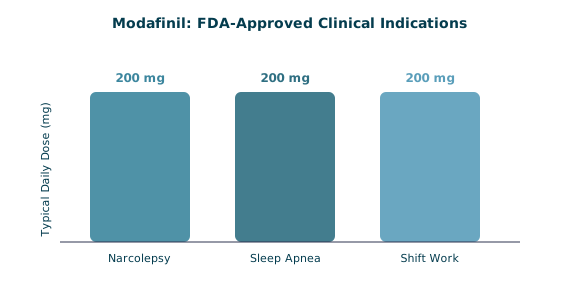
Modafinil is a non-amphetamine central nervous system stimulant with wakefulness-promoting properties. In the United States, it is FDA-approved for three conditions in adults: narcolepsy (a sleep disorder causing sudden, uncontrollable sleep attacks), obstructive sleep apnea with residual excessive sleepiness despite CPAP therapy, and shift work sleep disorder. 2
The standard prescribed dose is 200 mg once daily in the morning for narcolepsy and sleep apnea. For shift workers, 200 mg is taken approximately one hour before the start of the work shift. 2 Off-label use for conditions such as attention difficulties, cancer-related fatigue, and cognitive enhancement in healthy adults also exists, though none of these uses carry formal regulatory approval.
Modafinil belongs to a class sometimes called “eugeroics” (from the Greek for “good arousal”). It is distinct from traditional stimulants such as amphetamine or methylphenidate in its pharmacology and, importantly, its lower risk of euphoria and dependence, though misuse is still possible.
How Does Modafinil Work in the Brain?
Modafinil’s exact mechanism is not fully understood, but research points to several interconnected pathways. Its primary action is weak inhibition of the dopamine transporter (DAT), which increases extracellular dopamine levels in the brain without triggering the intense reward signals seen with cocaine or amphetamines. 3
Beyond dopamine, modafinil also raises norepinephrine levels. Both of these effects are thought to drive wakefulness by increasing activity in the prefrontal cortex, the brain region responsible for attention and decision-making. 3
The Role of Orexin and Histamine
Two other systems matter here. Modafinil activates orexin (also called hypocretin) neurons in the hypothalamus. Orexin is a key regulator of arousal; people with narcolepsy have very low orexin levels, which is partly why modafinil helps them. It also indirectly increases histamine activity, another wakefulness signal. 4
This multi-system action is what gives modafinil a different profile from older stimulants. It promotes wakefulness without preventing sleep when the opportunity arises, which is useful in variable-schedule settings such as shift work or military operations. 4
Modafinil’s relatively low euphoria risk comes from its weaker and indirect dopamine activity. Amphetamine-type stimulants flood dopamine receptors quickly; modafinil raises dopamine more gradually through transporter blockade. This does not make it risk-free, but it helps explain why dependence is less commonly reported.
What Does Research Say About Cognitive Benefits?
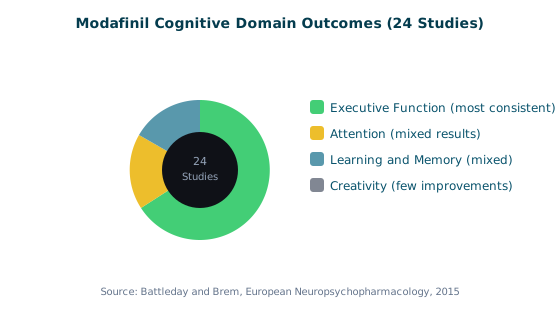
A 2015 systematic review published in the European Neuropsychopharmacology journal analyzed 24 placebo-controlled studies of modafinil in healthy, non-sleep-deprived adults. The reviewers found that studies using basic cognitive tests showed inconsistent results, but studies that used more complex tasks found consistent improvements in attention, executive function, and learning. 1
Importantly, the review noted that modafinil did not reliably enhance creativity or performance on simple tasks, and a few studies actually found it slightly slowed creative thinking. This is a meaningful limitation: it may sharpen analytical, sequential thinking while having neutral or mildly negative effects on open-ended problem-solving.
Working Memory and Episodic Memory
A 2017 double-blind, randomized, placebo-controlled study from the University of Cambridge examined single-dose modafinil in patients with remitted depression, a population known to have persistent cognitive deficits. The researchers found significant improvements in episodic memory (the ability to recall events) and working memory (holding and manipulating information in mind) compared to placebo. 5
It is worth noting that this study was conducted in people with existing cognitive deficits, not in healthy individuals with normal baseline memory. The findings may not translate directly to people without underlying impairment.
Wakefulness Benefits: The Strongest Evidence
The most consistent and well-supported benefit of modafinil is its ability to maintain wakefulness and reduce cognitive decline under sleep deprivation. A double-blind, placebo-controlled laboratory study published in the journal Sleep found that modafinil significantly reduced performance decrements in participants kept awake for extended periods during a 25-day protocol, including improvements in alertness and cognitive-psychological performance. 6
This is where modafinil’s evidence base is clearest: it helps people stay alert and perform cognitively demanding tasks when they would otherwise be impaired by sleep loss or irregular schedules. This is why it has genuine clinical value for shift workers, people recovering from certain neurological conditions, and those with narcolepsy. 2
Modafinil in Critically Ill and Post-Stroke Patients
A 2025 narrative review published in the journal Clocks and Sleep examined nine clinical studies (including two randomized controlled trials) covering approximately 950 patients in intensive care settings. The review found that modafinil may help promote wakefulness in selected critically ill patients and could support their participation in physical rehabilitation. 7
However, the authors were clear that conclusions about efficacy and safety in this group remain limited by small sample sizes. This is preliminary evidence, not a strong recommendation.
Executive Function: The Most Reliably Affected Domain
Across the research, executive function shows the most consistent response to modafinil. Executive function is an umbrella term for mental skills that include planning, decision-making, cognitive flexibility, and inhibitory control. These are the processes you use when juggling competing priorities, switching between tasks, or filtering irrelevant information.
The neurobiology supports this. Research documented in PMC found that modafinil activates fronto-cortical areas involved in higher cognitive functions, even at doses producing plasma concentrations similar to those used clinically. 4 The prefrontal cortex, heavily involved in executive tasks, is sensitive to dopamine and norepinephrine levels, both of which modafinil raises.
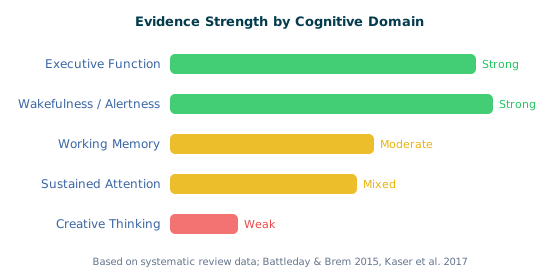
A meta-analysis noted that while earlier reviews confidently called modafinil safe and effective, more recent aggregated analyses show the benefits are neither as uniform nor as strong as a single standout study might suggest. The effect appears real, particularly for executive tasks, but it is not a guarantee for every individual. 8
What Are the Risks and Side Effects?
Modafinil is generally considered well-tolerated. The most commonly reported adverse effects, affecting fewer than 10% of users, are headache and nausea. Other effects reported by 5% to 10% of users include anxiety, insomnia, dizziness, diarrhea, and rhinitis. 2
A large-scale safety study covering 1,529 outpatients across multiple conditions found headache in 34% of modafinil users compared to 23% on placebo, and nausea in 11% versus 3% on placebo. These side effects were generally mild to moderate and similar across patient groups. 9
A 2024 systematic review and meta-analysis covering 54 studies found that side effect profiles differ meaningfully by the condition being treated. Shift work patients had particularly elevated risks of insomnia and anxiety compared to placebo. People using it off-label for ADHD-related symptoms showed increased risks of insomnia and decreased appetite. 10
When to Consider Prescription Treatment
If a doctor has diagnosed you with narcolepsy, obstructive sleep apnea with residual sleepiness, or shift work sleep disorder, modafinil is one of the prescription options that may be discussed. Several generic formulations are available and are widely prescribed under their brand identities. Always consult a doctor before use.
Modafinil Formulations Available at PillsPlace
PillsPlace stocks a range of prescription-grade modafinil generics for patients with valid prescriptions or in regions where such purchases are legally permitted. The following options may be discussed with your healthcare provider:
- Modalert 200 – 200 mg modafinil tablet. Consult a doctor before use.
- Modvigil 200 – 200 mg modafinil tablet. Consult a doctor before use.
- Modaheal 200 Mg – 200 mg modafinil tablet. Consult a doctor before use.
- Modalert 100mg – 100 mg modafinil tablet for lower-dose requirements. Consult a doctor before use.
These products are available for adults with appropriate indications. Always consult a licensed healthcare provider before starting any medication.
Conclusion
Modafinil is a well-studied wakefulness-promoting medication with genuine benefits for people who suffer from sleep-related conditions. Its strongest evidence is in maintaining alertness and cognitive performance under conditions of sleep deprivation or sleep disorder. For executive function, the evidence across complex cognitive tasks is fairly consistent.
For healthy, well-rested adults hoping to use it purely as a productivity tool, the evidence is more equivocal. Some studies show benefit; others find minimal effect or even slight impairment in creative tasks. Honest conversations with your doctor, grounded in your specific situation, are the right starting point.
Side effects are generally mild but not absent. Rare serious reactions do occur. Prescription status and drug interactions make this a medication that should not be taken without medical supervision.
FAQs.
What is modafinil FDA-approved to treat?
Does modafinil actually improve memory?
How does modafinil promote wakefulness?
What are the most common side effects?
Can modafinil be taken without a prescription?
References
- Battleday R.M., Brem A.K. “Modafinil for cognitive neuroenhancement in healthy non-sleep-deprived subjects: A systematic review.” European Neuropsychopharmacology, 2015. View source
- Greenblatt K., Adams N. “Modafinil.” StatPearls, NCBI Bookshelf, National Institutes of Health, 2023. View source
- Minzenberg M.J., Carter C.S. “Modafinil: A Review of Neurochemical Actions and Effects on Cognition.” Neuropsychopharmacology, 2008. View source
- Mereu M., Bonci A., Newman A.H., Tanda G. “The neurobiology of modafinil as an enhancer of cognitive performance and a potential treatment for substance use disorders.” Psychopharmacology, PMC, 2013. View source
- Kaser M., Deakin J.B., Michael A., et al. “Modafinil Improves Episodic Memory and Working Memory Cognition in Patients With Remitted Depression: A Double-Blind, Randomized, Placebo-Controlled Study.” Biological Psychiatry: Cognitive Neuroscience and Neuroimaging, 2017. View source
- Cohen D.A., Wang W., Wyatt J.K., et al. “Effect of modafinil on impairments in neurobehavioral performance and learning associated with extended wakefulness and circadian misalignment.” Sleep, 2010. View source
- Kakavas S., Karayiannis D. “Modafinil for Promoting Wakefulness in Critically Ill Patients: Current Evidence and Perspectives.” Clocks and Sleep, 2025. View source
- Kredlow M.A., et al. “The Efficacy of Modafinil as a Cognitive Enhancer: A Systematic Review and Meta-Analysis.” Journal of Clinical Psychopharmacology, 2019. View source
- Roth T., Schwartz J.R.L., Hirshkowitz M., et al. “Evaluation of the Safety of Modafinil for Treatment of Excessive Sleepiness.” Journal of Clinical Sleep Medicine, 2007. View source
- Jacobs Z.G., et al. “Assessing Condition-Specific Adverse Event Profiles of Modafinil for Labelled and Off-Label Uses: A Systematic Review and Meta-Analysis.” PubMed, 2024. View source