If you’ve searched for high-dose sildenafil tablets, you’ve probably come across Cenforce 200. It’s a common question for men who feel like the usual doses aren’t cutting it anymore: does going higher actually work better, or does it just mean more side effects? The honest answer sits somewhere in between, and it depends heavily on why the standard dose isn’t working in the first place.
This article breaks down what sildenafil citrate is, what the clinical research on 200 mg dosing actually found, and where a doctor’s involvement matters most before you consider any high-dose PDE5 inhibitor.
TL;DR: Sildenafil citrate is a PDE5 inhibitor that improves blood flow to the penis during arousal, and clinical trials found it improved erections in roughly 82% of men within 12 weeks.3 High-dose (200 mg) sildenafil is not standard first-line dosing and comes with a higher rate of side effects. If symptoms persist, speaking with a doctor is the most reliable next step.
What Is Cenforce 200, Exactly?
Cenforce 200 is a generic tablet containing 200 mg of sildenafil citrate, the same active compound found in the FDA-approved drug sold under the brand name Viagra.1 Sildenafil belongs to a drug class called PDE5 inhibitors, which were first approved for erectile dysfunction (ED) in the United States in 1998.1
What matters for your safety is the dose. The FDA-approved dosing range for sildenafil tops out at 100 mg, taken as needed and not more than once in 24 hours.1 A 200 mg tablet is double the highest standard approved dose, which is why it should never be a starting point without medical supervision.
How Does Sildenafil Actually Work in the Body?
During sexual stimulation, your body releases nitric oxide, a molecule that relaxes blood vessels, in the erectile tissue of the penis. This triggers a rise in a second molecule called cGMP, which causes smooth muscle to relax and blood flow to increase.2 An enzyme called PDE5 normally breaks cGMP back down. Sildenafil blocks PDE5, so cGMP stays elevated longer, helping the erection form and hold.2
This is why sildenafil only works with sexual stimulation. It doesn’t create arousal on its own, it simply removes one of the biological brakes on the process.
Does the 200 mg Dose Actually Work Better Than Standard Doses?
This is the core question, and the clearest data comes from a study of 54 men who had already failed to respond to a standard 100 mg dose of sildenafil at home. Researchers escalated their dose up to 200 mg under supervision. After four weeks, 37% improved on 100 mg, 46.3% improved on 150 mg, and 68% improved on the 200 mg dose.3
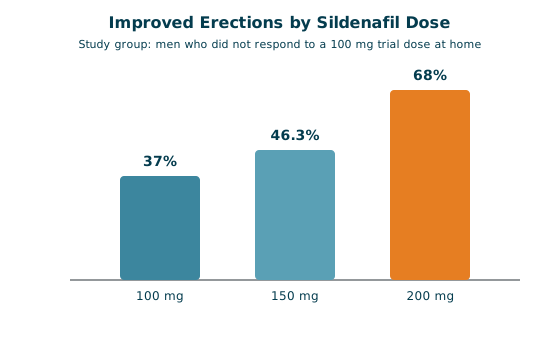
That sounds like a strong result for the higher dose, but there’s an important trade-off. Of the men who received the maximal dose, 63% reported side effects, including headache, facial flushing, dyspepsia, nasal congestion, and visual disturbances.3 Nearly a third of the men who did respond decided to stop treatment because the side effects were too much to tolerate.3
What Do the Broader Clinical Trials Show About Sildenafil for ED?
Outside of high-dose research, sildenafil has one of the largest evidence bases of any ED treatment. In a 26-week, placebo-controlled trial, 82% of men on sildenafil reported improved erections at 12 weeks, compared with 24% on placebo. That gap held steady at 26 weeks, with 79% versus 23%.4
A pooled analysis of 14 trials found that men on sildenafil had successful intercourse in 57% of attempts, compared with 21% for placebo, and 83% of sildenafil users had at least one successful attempt during treatment.5 These results held up regardless of age or the underlying cause of ED, whether related to diabetes, cardiovascular disease, or psychological factors.5
How Common Is Erectile Dysfunction, and What Does It Signal?
Erectile dysfunction affects roughly 18.4% of American men aged 20 and older, which works out to about 18 million men.6 Prevalence rises sharply with age, ranging from around 2% in men under 40 to as high as 86% in men over 80.7
ED is not just an inconvenience. It’s often an early warning sign of cardiovascular disease, since the blood vessels involved in erections are some of the smallest in the body and tend to show damage before larger arteries do.8 That’s one reason a doctor’s evaluation matters more than simply reaching for a stronger pill.
What Are the Side Effects and Safety Risks to Know About?
Common sildenafil side effects include headache, facial flushing, indigestion, nasal congestion, dizziness, and temporary visual changes such as a blue tint to vision.3 These are usually mild to moderate and tend to fade as the dose wears off, though they become more frequent at higher doses.3
The most serious risk involves nitrates, a class of medication used for chest pain or heart conditions. Combining sildenafil with nitrates such as nitroglycerin can cause a sudden, dangerous drop in blood pressure.9 Men with heart disease, uncontrolled high or low blood pressure, or a recent stroke or heart attack should not take sildenafil without a doctor’s clearance.
Is It Safe to Buy High-Dose Generics Without a Prescription?
Generic sildenafil products manufactured overseas, including 200 mg tablets, are not FDA-approved formulations in the United States. Sildenafil citrate itself is FDA-approved as the active ingredient in Viagra, but products sold without a prescription or medical oversight fall outside that approval process.9 The FDA has repeatedly warned that products sold online for sexual performance have been found to contain undeclared or mismeasured PDE5 inhibitors, which raises the risk of dangerous interactions, especially with nitrates.9
When to Consider Prescription Treatment
Medical Treatment Options
PDE5 inhibitors come in several strengths and formulations. Here’s how the commonly searched options compare. Always consult a doctor before use.
Cenforce 200: sildenafil citrate 200 mg. A high-strength generic tablet, generally reserved for men who have not responded to standard sildenafil dosing under a doctor’s guidance.
Fildena Double 200 mg: sildenafil citrate 200 mg. Another high-strength generic formulation with the same active ingredient and the same dosing considerations as above.
Kamagra Oral Jelly: sildenafil citrate in an oral gel form, typically dosed at 100 mg per sachet, offering an alternative for men who have difficulty swallowing tablets.
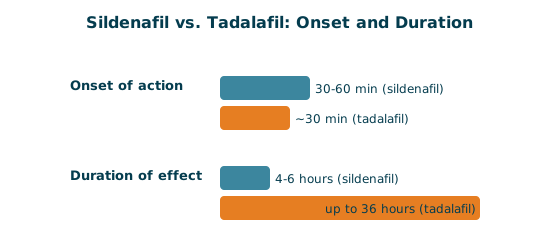
Tadalista 20 mg tablet: tadalafil 20 mg, a longer-acting PDE5 inhibitor that can remain effective for up to 36 hours, useful for men who prefer not to time dosing around sexual activity.
Always consult a doctor before use. A licensed provider can confirm the right medication, dose, and whether a PDE5 inhibitor is appropriate for your health history.
Comparing the Options at a Glance
| Product | Active Ingredient | Strength | Typical Onset | Typical Duration |
|---|---|---|---|---|
| Cenforce 200 | Sildenafil citrate | 200 mg | 30-60 min | 4-6 hours |
| Fildena Double 200 mg | Sildenafil citrate | 200 mg | 30-60 min | 4-6 hours |
| Kamagra Oral Jelly | Sildenafil citrate | 100 mg (per sachet) | 15-45 min | 4-6 hours |
| Tadalista 20 mg | Tadalafil | 20 mg | ~30 min | up to 36 hours |
Key Takeaways
- PDE5 inhibitors work by boosting a natural blood flow pathway, not by creating arousal on their own.
- Standard-dose sildenafil already helps most men, with roughly 8 in 10 reporting improved erections in controlled trials.
- Higher doses can help select non-responders, but they come with a meaningfully higher rate of side effects.
- ED can be an early signal of cardiovascular disease, so a medical evaluation matters as much as the medication itself.
- Products bought without a prescription carry added risk, particularly around undeclared ingredients and nitrate interactions.
If ED has been affecting you for more than a few weeks, that’s worth bringing up with a doctor, not just working around. A proper evaluation can rule out underlying causes and help you find a dose and treatment that actually fits your health picture.
FAQs.
Is a 200 mg sildenafil dose safe for most men?
How long does sildenafil take to start working?
Can I take sildenafil with blood pressure medication?
Why do PDE5 inhibitors sometimes stop working?
Is erectile dysfunction always a sign of a serious health issue?
References
- Smith BP, Babos M. “Sildenafil.” StatPearls, NIH National Library of Medicine, 2023. View source
- Dhaliwal A, Gupta M. “PDE5 Inhibitors.” StatPearls, NIH National Library of Medicine, 2023. View source
- Seftel A. “High dose sildenafil citrate as a salvage therapy for severe erectile dysfunction.” Journal of Urology, 2003. View source
- “A dose-escalation study to assess the efficacy and safety of sildenafil citrate in men with erectile dysfunction.” PubMed, 2001. View source
- “Sildenafil for male erectile dysfunction: a systematic review and meta-analysis.” PubMed, 2002. View source
- Selvin E, Burnett AL, Platz EA. “Prevalence and Risk Factors for Erectile Dysfunction in the US.” American Journal of Medicine, 2007. View source
- “Prevalence of erectile dysfunction: a systematic review of population-based studies.” PubMed, 2002. View source
- Leslie SW, Sooriyamoorthy T. “Erectile Dysfunction.” StatPearls, NIH National Library of Medicine, 2024. View source
- U.S. Food and Drug Administration. “ENDUREA contains hidden drug ingredients.” FDA Medication Health Fraud Notices, 2024. View source