

If you have been dealing with erectile dysfunction (ED) and someone mentioned “low testosterone” as a possible cause, you are not alone in wondering how the two connect. It’s a fair question, and a common one in doctors’ offices. Testosterone is not the whole story behind ED, but it is a bigger part of it than most men realize.
This article breaks down what testosterone actually does for erectile function, how often low testosterone shows up alongside ED, what the clinical research says about testosterone therapy, and when it makes sense to talk to a doctor about testing.
TL;DR: Low testosterone (hypogonadism) affects roughly 39% of men over 45 1 and frequently overlaps with erectile dysfunction, though testosterone alone rarely explains ED on its own. Research shows testosterone therapy improves libido more reliably than it improves erections. If erections aren’t working the way they used to, talking with a doctor about a full evaluation, not just a testosterone test, is the most reliable next step.
How Are Testosterone and Erectile Dysfunction Connected?
Testosterone and erectile function are linked, but the relationship is more nuanced than “low testosterone causes ED.” Testosterone helps regulate the biological machinery involved in an erection, including nitric oxide synthase and phosphodiesterase type 5 (PDE5), two enzymes central to the erection process. 2 When testosterone drops significantly, this machinery can become less responsive, which is one reason some men who don’t respond well to standard ED medication turn out to have a hormone deficiency underneath it. 2
That said, testosterone is only one input among many. Blood flow, nerve function, psychological state, medications, and chronic conditions like diabetes all play a role too. Think of testosterone as one gear in a larger system rather than the single switch that turns erections on or off.
How Common Is Low Testosterone in Men With Erectile Dysfunction?
Low testosterone is far more common than most men expect. The Hypogonadism in Males (HIM) study found that roughly 39% of men aged 45 and older have some degree of hypogonadism, and prevalence climbs steeply with age. 1 Since erectile dysfunction and low libido are among the most recognizable symptoms of hypogonadism, the overlap between the two conditions is substantial. 3
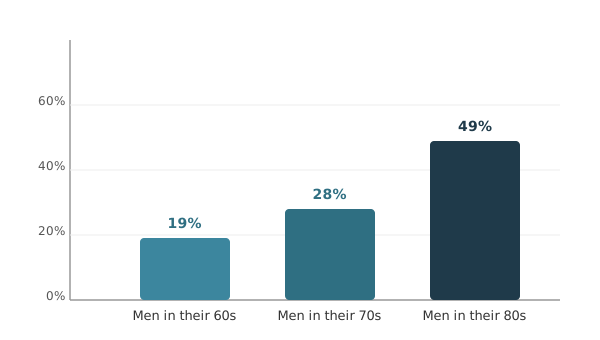
Beyond age, low testosterone is especially common among men with obesity, type 2 diabetes, or metabolic syndrome, groups where 30 to 50% may be affected. 4 Low testosterone is also an independent marker of cardiovascular risk, which is another reason doctors take hormone testing seriously rather than treating it as a lifestyle afterthought. 5
What Does Testosterone Actually Do for Erections?
Testosterone supports several processes needed for a normal erection. It helps maintain the smooth muscle and elastic tissue inside the penis, supports nitric oxide production (a molecule your body makes to relax blood vessels and allow blood to flow in), and helps regulate desire and arousal signals in the brain. 3
Much of what we know about the mechanical role of testosterone comes from animal studies. In an animal study using castrated rats, researchers found that testosterone deprivation led to vascular smooth muscle atrophy, venous leakage, and structural changes in penile tissue, changes that could be prevented with androgen replacement. 3 Human clinical evidence for the exact scale of this effect is still limited, though preliminary human studies support a similar vasodilating role for testosterone in penile arteries. 6
Can Testosterone Therapy Fix Erectile Dysfunction?
Sometimes, but not reliably on its own. A systematic review and meta-analysis of 17 randomized, placebo-controlled trials found that testosterone therapy produced a large improvement in libido, but only a modest, statistically inconsistent improvement in erectile function satisfaction. 7 A larger 2017 meta-analysis covering 2,298 men reached a similar conclusion: testosterone therapy helps most consistently with desire, and its benefit for erections specifically tends to be smaller and more variable. 8
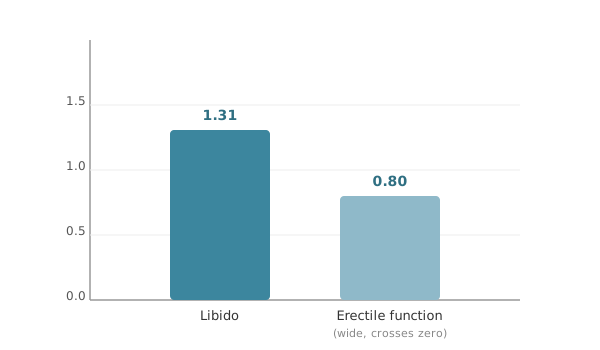
Where testosterone therapy tends to help most is in men who don’t respond fully to standard ED medication and also have confirmed low testosterone. In that group, adding testosterone can convert a meaningful share of non-responders into responders. 3 This is why an accurate diagnosis matters more than guessing.
Other Causes of Erectile Dysfunction Besides Low Testosterone
Erectile dysfunction affects an estimated 320 million men worldwide, and hormones are just one piece of a much larger picture. 10 Vascular disease, nerve damage, certain medications, and psychological factors are all common, and often more significant, contributors.
| Category | Common Examples | How It Affects Erections |
|---|---|---|
| Hormonal | Low testosterone, thyroid disorders | Reduces desire and can blunt the tissue response needed for firmness |
| Vascular | Atherosclerosis, high blood pressure, diabetes | Restricts blood flow needed to achieve and sustain an erection |
| Neurological | Nerve injury, spinal cord conditions, multiple sclerosis | Disrupts the nerve signals that trigger an erection |
| Psychological | Stress, anxiety, depression, relationship strain | Interferes with arousal signals from the brain |
| Medication-induced | Some antidepressants, blood pressure drugs | Can directly interfere with erectile physiology |
Because ED usually has more than one contributing factor, a doctor’s evaluation typically looks at cardiovascular health, blood sugar, medications, and mental health alongside a testosterone check, not testosterone in isolation.
When Should You See a Doctor?
A doctor can order a morning blood test to check total and free testosterone, since levels naturally fluctuate throughout the day. 9 They may also check blood sugar, cholesterol, and thyroid function, since these often overlap with both low testosterone and ED.
Medical Treatment Options
Treatment depends on the underlying cause. If testosterone is confirmed low and symptomatic, a doctor may discuss testosterone replacement therapy. If the primary issue is blood flow to the penis, PDE5 inhibitors are typically the first-line option regardless of testosterone status. 10 These medications work by blocking the PDE5 enzyme, which allows nitric oxide to keep blood vessels relaxed and improves blood flow during arousal. 11
PDE5 Inhibitor Options at PillsPlace
PillsPlace carries a range of tadalafil and sildenafil-based options for men who have been evaluated and prescribed a PDE5 inhibitor by their doctor, including Vidalista 60mg, Vidalista 80mg, Vidalista Black 80 mg, Kamagra Oral Jelly, and Kamagra 100mg. Tadalafil and sildenafil, the active ingredients in these products, are approved by the FDA in the United States as PDE5 inhibitors; regulatory status of specific branded formulations can vary by country. Always consult a doctor before use to confirm the right option and dose for your health profile, especially if you take nitrates or have cardiovascular disease.
The Bottom Line
Testosterone plays a real, measurable role in erectile function, but it’s rarely the whole explanation. Low testosterone is common, especially with age, obesity, and diabetes, and it’s worth checking if you’re dealing with both low desire and ED. But because vascular, neurological, and psychological factors are just as often involved, the most reliable path forward is a proper evaluation rather than assuming one hormone is to blame.
- Low testosterone affects roughly 39% of men over 45 and rises sharply with age
- Testosterone supports nitric oxide production and penile tissue health, but is one factor among several
- Testosterone therapy improves libido more consistently than it improves erectile function on its own
- A full evaluation, not just a testosterone test, gives the clearest picture of what’s causing ED
FAQs.
Does low testosterone always cause erectile dysfunction?
Can I raise testosterone naturally to help with ED?
How do I know if my ED is hormone-related?
Is testosterone therapy the same as ED medication?
At what age does testosterone start affecting erections?
References
- Sizar O, Leslie SW, Pico J. “Androgen Replacement: prevalence of hypogonadism by age decade.” StatPearls, NIH, 2026. View source
- “Erectile dysfunction and testosterone deficiency: mechanism and animal castration studies.” PubMed, 2008. View source
- Traish AM, et al. “A practical guide to male hypogonadism in the primary care setting: HIM study prevalence data.” PMC, NIH, 2010. View source
- “Hypogonadism in Men: prevalence in men over 45 and in men with obesity or type 2 diabetes.” Endocrine Society, 2022. View source
- Sizar O, et al. “Male Hypogonadism: cardiovascular risk and symptoms.” StatPearls, NIH, 2024. View source
- “Does testosterone have a role in erectile function? A literature review.” PubMed, 2006. View source
- “Testosterone use in men with sexual dysfunction: a systematic review and meta-analysis of randomized placebo-controlled trials.” PubMed, 2005. View source
- Rastrelli G, Corona G, Mannucci E, Maggi M. “Meta-analysis of Results of Testosterone Therapy on Sexual Function Based on International Index of Erectile Function Scores.” European Urology, PubMed, 2017. View source
- Sizar O, Leslie SW, Pico J. “Androgen Replacement: testing and monitoring guidance.” StatPearls, NIH, 2026. View source
- Dhaliwal A, Gupta M. “PDE5 Inhibitors: global ED prevalence and FDA-approved options.” StatPearls, NIH, 2023. View source
- “Mechanisms of action of PDE5 inhibition in erectile dysfunction.” PubMed, International Journal of Impotence Research, 2004. View source