Erectile dysfunction (ED) is more common than most people realize. Research from the NIH estimates that at least 150 million men globally live with the condition, and that by 2025 the figure could reach 322 million. If you have been researching treatment options, you have likely come across both brand-name sildenafil products and generic alternatives marketed at higher dose strengths. The question most men want answered is simple: are they the same, and is a higher dose actually better?
This article walks you through the clinical evidence on sildenafil citrate, explains what the dose numbers actually mean, and helps you understand what to ask your doctor at your next appointment. Many people compare the potency, efficacy and safety of cenforce 200 vs viagra while assessing their tereatment alternaties.
In Short: Both Cenforce 200 and Viagra rely on sildenafil citrate as their active ingredient. Regulatory agencies approve sildenafil for doses up to 100 mg, and clinical pharmacokinetic research published in PMC found that 25 to 100 mg represents the effective therapeutic range. Higher doses increase the risk of side effects without proportional gain in effectiveness. If your current ED treatment is not working well, speaking with a doctor is the most reliable next step.
What Is Sildenafil Citrate and How Does It Work?
Sildenafil citrate belongs to a class of medications called PDE5 inhibitors (phosphodiesterase type 5 inhibitors). It was the first oral treatment approved by the US Food and Drug Administration for erectile dysfunction, receiving that approval in March 1998. Understanding how it works helps you appreciate why dose adjustments are not simply a matter of “more is better.”
During sexual arousal, your body releases a molecule called nitric oxide into the smooth muscle tissue of the penis. Nitric oxide triggers a chain reaction that produces cyclic guanosine monophosphate (cGMP), a compound that relaxes blood vessel walls and allows blood to flow into the penis, producing an erection. PDE5 is the enzyme that breaks down cGMP and ends the erection.
Sildenafil blocks PDE5, which means cGMP stays active for longer after sexual stimulation occurs. It does not cause an erection on its own. Arousal is always required. This is a point that many men misunderstand before their first dose.
What Is the Difference Between Cenforce 200 vs Viagra?
At a chemical level, both products deliver sildenafil citrate as the active molecule. Viagra 100 mg is the brand-name formulation developed by Pfizer and is FDA-approved at doses of 25, 50, and 100 mg. Cenforce 200 is a generic product manufactured in India at a 200 mg dose strength, which is above the approved therapeutic range.
| Feature | Cenforce 200 mg | Viagra 100 mg |
|---|---|---|
| Active Ingredient | Sildenafil citrate | Sildenafil citrate |
| Dose Strength | 200 mg (above approved range) | 100 mg (maximum approved dose) |
| Regulatory Status | Not FDA-approved; generic product | FDA-approved since 1998 |
| Manufacturer Oversight | Varies; no US regulatory review | Pfizer; subject to FDA manufacturing standards |
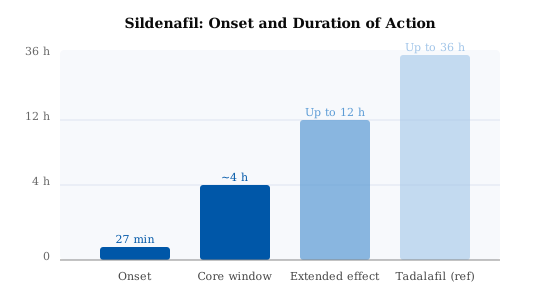
| Onset of Action | Approximately 30 to 60 minutes | Approximately 27 to 60 minutes |
| Duration of Action | Approximately 4 to 6 hours | Approximately 4 to 6 hours |
| Side effect Risk at Dose | Higher; dose exceeds clinical guidance | Standard; consistent with trial data |
| Requires Prescription | Yes, in most jurisdictions | Yes |
Does a Higher Dose Mean Better Results?
This is a Reasonable question. If 100 mg works, would 200 mg Work Better? The Short Answer from Clinical research is: not meaningfully, and with more risk.
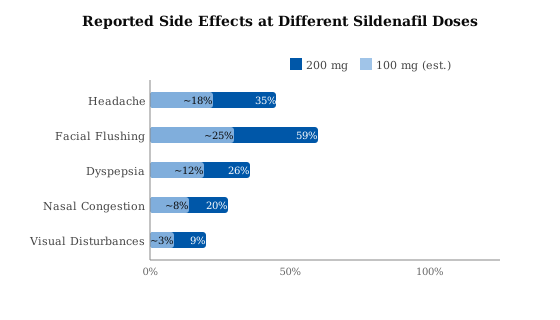
A study published in PubMed examined 54 patients who had not responded to the standard 100 mg dose and escalated them up to 200 mg. After four weeks, 68% reported some improvement in erections at the 200 mg dose, compared to 37% at 100 mg. However, 63% of participants at the 200 mg dose experienced adverse effects, including headache, facial flushing, nasal congestion, dizziness, and visual disturbances. A substantial number chose to stop treatment because the side effects were not tolerable.
The key finding here is that 200 mg was used as a last-resort option for people who had already failed the standard dose, under careful medical supervision. It was not used as a starting point. Using 200 mg as a first dose without medical guidance places you at higher risk of side effects without a reliable benefit advantage over a lower, approved dose.
How Do These Medications Actually Perform Over Time?
Long-term effectiveness data for sildenafil at the approved dose range (25 to 100 mg) is genuinely impressive. A pooled analysis of 11 double-blind, placebo-controlled trials covering 2,667 men found statistically significant improvements in erectile function across all age groups, all ED severity levels, and all major comorbidities including diabetes and cardiovascular disease.
Among men who continued therapy for one to three years, more than 95% reported satisfaction with the effect of treatment on their erections. That is a strong signal that the medication, at its approved doses, continues to work over time without meaningful loss of effect.
It is also worth noting that onset varies between individuals. Research in PMC found the median time to onset of erections after a 50 mg dose was approximately 27 minutes, with a range of 12 to 70 minutes. About 35% of patients noticed an effect within 14 minutes. A high-fat meal can delay absorption by up to 60 minutes and reduce peak concentration, so taking the medication on an empty stomach or after a light meal is generally preferred.
Similar Medication
Vidalista 20 mg
Kamagra 100 mg
Tadalista 60
Fildena Double 200 mg
What Are the Safety Considerations?
Sildenafil has a well-characterized safety profile built on more than 25 years of clinical use. That said, there are specific situations where the medication carries real risk.
Absolute Contraindications you Need to Know About
Nitrate medications (such as nitroglycerin, isosorbide mononitrate, or isosorbide dinitrate) must never be combined with any PDE5 inhibitor. Both nitrates and sildenafil lower blood pressure through overlapping pathways. Using them together can cause a rapid, life-threatening drop in blood pressure. This contraindication applies regardless of dose.
Men who use alpha-blockers for blood pressure or prostate conditions should also discuss sildenafil use carefully with their doctor, as combined use can also cause blood pressure to drop more than intended.
Common Side-effects at Approved Doses
The most frequently reported effects with standard dosing include headache, facial flushing, nasal congestion, indigestion, and mild visual changes (such as a temporary blue tint to vision). These are generally mild and short-lived. At doses above 100 mg, the incidence and intensity of these effects increase considerably, as the high-dose study data demonstrated.
A Note on Rare But Serious Risks
The NIH StatPearls review notes that sildenafil may, in rare cases, increase the risk of non-arteritic anterior ischemic optic neuropathy (NAION), a condition affecting blood flow to the optic nerve, particularly in men over 50 who have pre-existing risk factors. A prolonged erection lasting more than four hours (priapism) is another rare but serious risk that requires immediate medical attention.
When to Consider Prescription Treatment Options
PDE5 inhibitors including sildenafil-based products are prescription medications for a reason. They interact with other drugs, require dosage matching to individual health profiles, and carry genuine cardiovascular considerations. A doctor can assess which option suits your specific situation.
Generic sildenafil formulations are legally available in many countries and may carry the same active compound as branded versions at lower cost. Cenforce 200 mg is one such generic, though its 200 mg dose sits above the approved clinical range. If cost is a barrier, ask your doctor about generic 25 mg, 50 mg, or 100 mg sildenafil, which are widely available and have the same evidence base as branded versions.
Other Prescription PDE5 inhibitors such as tadalafil (available as a 5 to 20 mg dose) offer a longer duration of action (up to 36 hours) and are unaffected by food intake. Some men prefer this flexibility. A doctor can help you evaluate whether sildenafil, tadalafil, or another option better fits your lifestyle and health status.
Always consult a doctor before use. Self-prescribing at elevated doses carries risks that outweigh any perceived benefit without medical oversight.
| Sildenafil may suit you if… | Talk to a doctor first if… |
|---|---|
|
|
What Should You Take Away From This Comparison?
Cenforce 200 vs Viagra 100 mg share the same active compound. The clinical evidence is clear that sildenafil at 25 to 100 mg represents the effective and approved therapeutic range. The 200 mg dose has not been shown to deliver proportionally better results and carries a meaningfully higher burden of side effects.
If you have been researching these products, the most productive next step is not choosing between the two on your own. It is having a frank conversation with a doctor about what is driving your ED, what medications you currently take, and what dose and formulation fits your overall health picture. That conversation will do more for you than any product comparison can.
A doctor can also check whether underlying conditions like high blood pressure, diabetes, or cardiovascular disease are contributing factors, which often deserve attention in their own right.
FAQs.
Do Cenforce 200 and Viagra contain the same active ingredient?
Is the 200 mg sildenafil dose safe?
How quickly does sildenafil start working?
Can sildenafil be taken daily?
What medications should never be combined with sildenafil?
References
- StatPearls, National Library of Medicine. “Erectile Dysfunction.” NCBI Bookshelf, Updated January 2024. View source
- Ayta IA, McKinlay JB, Krane RJ. “The likely worldwide increase in erectile dysfunction between 1995 and 2025 and some possible policy consequences.” BJU International, 1999. View source
- Muirhead GJ et al. “A population pharmacokinetic analysis of sildenafil citrate in patients with erectile dysfunction.” PMC / British Journal of Clinical Pharmacology, 2002. View source
- Dhaliwal A, Gupta M. “Sildenafil.” StatPearls, NCBI Bookshelf, National Library of Medicine, Updated 2023. View source
- Eardley I et al. “Sildenafil in the treatment of erectile dysfunction: an overview of the clinical evidence.” PMC / Vascular Health and Risk Management, 2007. View source
- Andersson KE. “PDE5 inhibitors: pharmacology and clinical applications 20 years after sildenafil discovery.” PMC / British Journal of Pharmacology, 2018. View source
- Goldmeier D, Lamba H. “High dose sildenafil citrate as a salvage therapy for severe erectile dysfunction.” PubMed / International Journal of Impotence Research, 2002. View source
- Carson CC, Burnett AL, Levine LA, et al. “The efficacy of sildenafil citrate (Viagra) in clinical populations: an update.” PubMed / Urology, 2002. View source
- Montorsi F et al. “Onset and duration of action of sildenafil for the treatment of erectile dysfunction.” PMC / International Journal of Impotence Research, 2004. View source
- Dhaliwal A, Gupta M. “PDE5 Inhibitors.” StatPearls, NCBI Bookshelf, National Library of Medicine, Updated 2023. View source